What’s being assessed at a flight school selection process?
The aim of this guide is to give aspiring and future pilots and insight into what attributes flight schools and airlines are looking for, when recruiting a cadet pilot.
If you’ve got an upcoming airline pilot assessment with one of the large flight schools such as L3 Harris, CAE, FTE, Leading Edge, Skyborne or a cadet pilot assessment for schemes such as the British Airways Speedbird Academy, Aer Lingus Future Pilot Programme, TUI MPL and easyJet MPL, then you are likely thinking about what it is they are actually assessing you on. Broadly speaking, they will be using a range of tools to assess your:
- Motivation
- Trainability
- Employability
So let’s take a look at each of those areas so that you have a better understanding of each!

Motivation
Motivation for the career of an airline pilot is a key factor in the assessment process – the industry wants to recruit people who have a passion for aviation, have researched the career of a pilot, understand the role of a First Officer and a Captain and their wider interactions with the other people in the airline, and know the benefits and risks of the career.
Motivated people with a particular interest in something tend to achieve a higher standard, purely because they enjoy it. Most pilots we fly with have always had an interest in planes, perhaps flying model aircraft, attending airshows or being in the Air Cadets when they were younger, or embarking on an educational course or career in the field of aviation. We are all enthusiasts in the flight deck and spending time with like minded people on the flight deck makes for a more enjoyable working environment!
So when applying for flight schools or an airline cadet scheme, it’s imperative that you can demonstrate motivation to become a pilot throughout the process; on your CV, application form and during the interview!
Trainability
Trainability is key measure to determine your suitability to pilot training for both ground school and flight school, as well as to provide an indication of how well you will adapt to the airline environment (multi-crew flying and type rating).
With trainability, the lessons are taught and you are then required to pass an exam or reach a required standard – something that airline pilots do every day on the line and every six months when they go to the simulator. The first indication of whether you are likely to be trainable is your educational standard – in other words, if you have GCSEs, A-Levels, a degree or some other qualification and you reached a reasonable standard in your subjects, then a flight school can extrapolate that you are able to sit down, assimilate information, work hard and pass the exams. That’s something you will have to do at flight school; in a six to nine month period, you will be required to learn the subject matter of fourteen topics and pass the exams to a high standard.
The next method to measure your trainability is psychometric testing, in particular the aptitude elements, these being; numerical, verbal, scientific, cognitive, working memory, multi tasking and coordination. Whilst these tests appear to have nothing to do with your ability to fly a plane, there is good industry evidence and correlation between doing well in these tests and meeting the required standards during flight training.
Employability
Employability is a measure of your ability to meet the competencies required of an airline pilot and you can read more about these in our pilot competencies guide. It’s a well known fact that you can have the motivation and be trainable, but still not be employable and that’s because you lack the competencies to a be a pilot; teamwork, leadership, communication, workload management, decision making, knowledge and customer service.
When you go for a flight school or airline cadet pilot assessment, you won’t be expected to demonstrate these skills to airline pilot standard, but you will be expected to show some evidence of them. Staying at home and being proficient in flight simulator will not make you employable! The industry needs people who have experience of working in teams, leading others and communicating well, making decisions and managing tasks as well as dealing with customers.
Believe it or not, one of the Directors at AirlinePrep developed all of their initial competencies working for McDonalds! If you give it some thought, McDonalds employees have to:
- Work in teams
- Adhere to strict operating standards
- Comply with food safety standards
- Talk with customers and give a good service
- Manage wastage (cost)
- Work in a high pressure environment
- Communicate with each other to ensure the operation runs smoothly
All of those are skills that a pilot has to use on a daily basis and you must start acquiring those skills now! You can acquire those competencies in the workplace, volunteering, playing sports or getting involved in clubs.
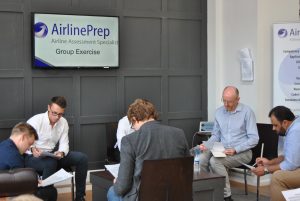
The flight school or airline can assess your competencies through a range of assessments including the interview, group exercise and personality questionnaire which is part of the psychometric testing.
We can assess your motivation, trainability and employability on our courses in a professional and friendly training environment, ensuring that you give the best version of yourself when applying to flight school!
Our courses are perfect preparation for your forthcoming Airline Pilot interview and assessment. Courses include:
- 1 to 1 competency based interview
- Group exercises
- Numerical & verbal reasoning
- Maths refresher training
- Interview training
- Group Exercise training
- Career development and pilot competencies seminar